Tuesday, September 7, 2010

The View From Parque Juarez

Last November we moved from Parque Juarez, where we rented for eight months, to a beautiful home which we bought, once we decided we couldn't leave San Miguel as soon as  we had originally planned.  The city takes its hold on you almost immediately.  You feel that you have been here forever, and also that you just arrived.  So now, from our new house in La Aldea, I say adios to our life on the park.  In memoriam: "The rooftop terrace on our house on Diezmo Viejo in San Miguel de Allende looks out over Parque Juarez. Basketball leagues, Saturday morning zumba, bike riders, dog walkers, balloon vendors, ice cream men, tienda keepers, Tai Chi instructors, kids, high school bands, grandparents, lovers, and skateboarders all use the park as their backyard.  At dusk when the blackbirds come out and the garzas flock to the trees in the chorro above us, it feels like the happiest place in the world."  Only our physical address has changed.  The city is still this incredibly happy place.

Zumba on a Saturday morning in the park.
The boys with the police horse in front of our house on Diezmo Viejo.

The boys swimming with friends in the park.  A no-no, it turns out.

Sunday, September 5, 2010

A Day in Tulum, Before Heading Towards Belize

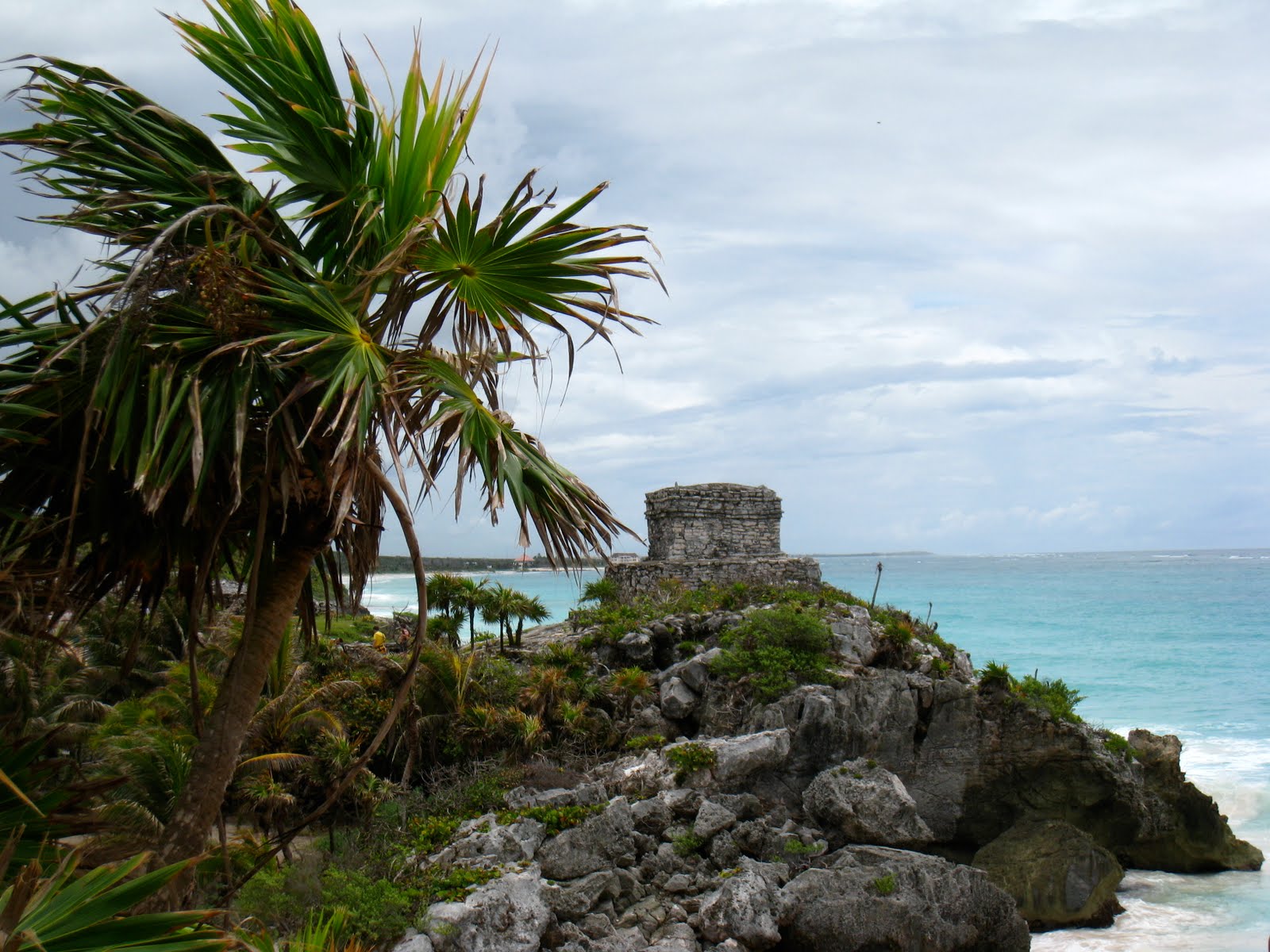
The view from the ramparts at Tulum down to the beach.
July 5: Left Casa Cenote, and with a little help from Sam's mom and an old bank card, managed to buy  our way out of the beach and head further south for the rest of the week.  First we took a quick side trip to Tulum, kind of digging the flexibility of nowhere to go, with no plans at all.  For me, the site was much more interesting than Chichen Itza, but that's just because of its spectacular setting.  Hard to beat 1,000-year-old ruins cheek by jowl with incredibly clear water and the chance to walk down from the ramparts for a swim.


Fourth of July, Mexican Style

July 4: Hit the road immediately following our unpleasant encounter with the owners of the beach condo, with no destination, but south.  We had been told a hurricane was coming and heading north--we had already been besieged somewhat by Alex, a week earlier--so outrun this one and head south was our plan.  The sense of relief that we were leaving this unpleasant situation behind us was incredibly liberating.  The boys had a DVD player in the back seat, we had air-con in the front seat, and, most exhilarating, a stash of pesos that we found in the glove compartment.  We knew we could survive at least through dinner.

So we pulled in for one night at Casa Cenote, a beachfront inn owned by an American named Gary who hosts a Texas-style BBQ every Sunday.  Figured there'd have to be something good on tap for Independence Day.  The place was a bit run down but had free kayaks, a cenote across the street and didn't ask for any money up front: we could put our heads down for a night until we found a source for some cash.  And there was snorkel equipment.  And cold beer.  And BBQ.  There wasn't much more we needed.
 The view from our bedroom at Casa Cenote. Not a bad second stop after horrendous Puerto Adventuras.


Mason heads out to the cenote across the street.

The Flamingos of Rio Lagartos

July 2: Decided to take a day trip from Valladolid to the sleepy little town of Rio Lagartos, on the Gulf, exactly an hour north.  Thought it might be a bust after our rather odd drive along the rest of this same coast, west of here.  But it turned out to be a real highlight of the trip.  Sam has never been on safari, nor seen a pack of one animal, represented by the thousands, so he was particularly thrilled with our adventure.
The boat trip took us past a salt factory that still exports tons of salt around the world every year, as well as mud baths, where the kids got off the boat and slathered themselves.  This was a traditional natural remedy for Mayans to fight mosquitoes and the heat.

Some of the flamingos we encountered.


Next stop: A deserted island.


And finally, one last cenote at the town swimming hole.

Friday, September 3, 2010

Chichen Itza: Ho Hum

June 30: Left Izamal behind and went an hour farther east to Valladolid via Chichen Itza.  First impression was that the site was grand, but way too commercialized with vendors all over the grounds hawking Mayan calendars, tie-dyed t-shirts, stone jaguars, and ugly jewelry.  With so much detracting from the view, it's hard to fathom the history of the ruins and what went into their making.  Fortunately, we saw several other sites during our five weeks in the Yucatan that were stunning and made up for this one.

An old hacienda we spotted while driving to the ruins.
Chac, the rain god.

Izamal, the Yellow City of the Yucatan


If anyone is out there reading this, now comes the boring stuff.  I need to chronicle this trip for my family, so we remember how we spent our time in Mexico.

June 26: Drove to Mexico City and caught a flight to Merida.  Rented a car and headed one hour east to this beautiful little town of Izamal, supposedly the only place a pope ever touched down (in 1983).  In his honor the town was painted egg-yolk yellow (at least the Mexican shade of egg yolks.  The eggs are so vivid down here.  And are never refrigerated.  Peanut butter?  Goes in the fridge.  Eggs? Right on the counter for days, next to the stove.  

We spent four nights here at the Macan Che B&B, where the dining palapa was so hot and still that Sam turned into Sweaty.  Never seen him perspire so much in my life.  We were warned about the heat in the Yucatan in the heart of summer, but what can you do when you've got kids and they've got school and all you've got are those hot seven weeks.  The inn had a cool little rock-bottom pool amidst an acre of very lush gardens so the boys spent most of their time there.  Unless we were frog-marching them around the town to see the convent (see below), climb the pyramid, and watch Mexico play in the World Cup from a tiny hot restaurant called ?

We did get some great guayabera shirts from neighboring Kimbali, and drove along the Gulf Coast an hour north to towns like Telchac Puerto and Santa Catarina, which were oddly deserted and looked completely abandoned.  When we stopped to swim on a driftwood-strewn beach, there was not a soul in town until a couple came down to the shore to see what we were doing.  We asked where all the people were and they told us, "Only ten families live here."  And the tourists?  "The season begins in July."  This was June 29.  Boats were still stranded on shore.  Beachfront snacks shops were shuttered up.  The town had a long way to go to get ready for anyone in two days' time.  The only thing open was the Servefrio (the cold beer stand) so we bought a few cans and some Gatorade and Doritos for the boys.  And went in search of our first cenote.


Trials and Tribulations

A great view, while it lasted....
Not four hours after my last, lonely post from July 3, as we wrapped up week one in the Yucatan and prepared to spend a carefree, first-time-ever week at the beach with the kids, we were robbed of most of our earthly possessions, including the computer from which I had planned to document our summer.  Yup, we arrived at a condo on the Riviera Maya, in a place called Puerto Adventuras, which we would never have visited again, even if we hadn't been robbed.  We are not beachy resort people it turns out and this place was so not Mexican it left us feeling gross.  We unpacked everything (save a portable DVD player which was our saving grace, for one day, until we left it in the hot car and it self-destructed), plopped it all down in our new lodgings, headed out for a swim in the clear water before us, and voila, in the short time we spent frolicking in the small surf, someone entered through our sliding glass tours, pocketed all of our cash, credit cards, drivers' license, bank cards, cameras, iPods, watch, laptop, and anything else that might be considered useful to us during our seven-week vacation.  Boring story so I'll just include the email we sent out to our families informing them of our desperate situation.  Then, it's onward to the rest of the vacation, which, surprisingly had a marvelous silver lining and was all quite dandy in the end.

While we were swimming, an evil spirit was pawing through my underwear drawer.
The freshwater lagoon at Bacalar.  Is this really Mexico?
We had a little setback in our trip but I am amazed at how quickly we bounced back.  Our first hour at the beach, on the riviera Maya, last Saturday, we were completely robbed in our condo.  Went out to take a swim as soon as we arrived, walked back in and found everything we owned, save our clothes and books, etc. GONE.  What a total bummer.  computer, ipods, camera, all our money, bankcards, credit cards, Sam's wedding rolex, wallet, drivers license, stolen. To top it off, the owners accused us of staging the robbery, even after we spent two fruitless hours at the police station, leaving our kids in the condo alone! (I knew there was a reason we don't like the beach!)  He threatened to kick us out and bring the police to us to evict us.  The wife was a piece of work too.  I nearly ripped the guy's head off.  He ended up apologizing and giving us back our money for the week so we left  immediately and hit the road like vagabonds.  Bo was such a dear.  At the point where we were throwing everything into our bags the morning after the robbery (we got exactly one night there out of what was supposed to be a week of sun and fun at the beach, with anger and disgust, Bo says, "This has made us closer as a family. " Then he adds, "Well, looks like it's sun, fun and run!"  I thought they'd all fall apart since we were dragging them away from what was really the most gorgeous beach and lovely sand but they decided they didn't like the owners either and were fine with going.  Also, we told them they could watch a movie in the car (we'd left the DVD player in the car, fortunately) with the air conditioning on and they were happy as clams!

But it's turned out great. Found a neat place for one night on the beach and are now near Belize on the most gorgeous freshwater lagoon called Bacalar.  Staying in a huge cabin by the water at a place, Rancho Encantado.  It looks like Tahiti but is totally freshwater.  Sam's off at the lavanderia right now washing some clothes.  The boys each have their own computer in this internet cafe so they couldn't be more satisfied."

Saturday, July 3, 2010

Week One in the Yucatan

You can travel for miles on a two-lane white road through acres of scrub jungle, low-growing palm and banana trees, and green pirule trees with flowers on fire, the color of ripe oranges and burning embers.  You will see men and boys ride on the shoulder with bikes weighted down by neatly stacked bundles of logs, uniformly about two feet long with both ends carved to a rounded point.  You will see a nation of homeless dogs, some bloated and attacked by angry flocks of vultures, and bulls the size of a small cabin. What you won't see is a single cactus, or any standing water. Here in the Yucatan, mysterious home of the Maya and a culture of extremely friendly locals in spite of their history with foreigners, there are no lakes, no rivers, no lagoons.  There is water on all sides of the Peninsula, the Gulf of Mexico to the west and north, the Caribbean to the east, and beneath this lush, moist, wild landscape, flowing silently to these sources, is the subterranean system of caves, rivers and sinkholes called cenotes.

In our first week of a 5-week journey through the Yucatan and Chiapas, the Hillers family unwittingly embarked on a week-long cenote tour of the Yucatan, satisfying the kids lust for swimming and the parents desire to get out of the sun.

Mas ... tarde.

Tuesday, June 1, 2010

Early Morning in San Miguel

The village rooster was up early this morning.  4:33am and he's crowing out a few bars, somewhere west of here, from a courtyard or neighbor's roof.  A minute later he stops, probably startled by a feral cat creeping along the garden walls between houses, eying him with greed.  But his voice was enough to wake me, and make me wonder, what's he doing up at this hour?  What I am I doing up?  Then the grackle took over, that sleek blackbird with the evil yellow eyes and the 10-inch-long tail feather, whose posse lives in our yard during the day, drinking from the fountain, or standing warily on the pool stairs, bending their beaks into the water.  The mourning doves are not up yet.  They never start before six, sane, asleep and as regular as the San Antonio church bells. It must be 4:45am.  The bells, which ring every 15 minutes, have just clanked out three sets.  When we moved to this house last November, three to four blocks from the church, I was too aware of their rhythm, listening for twelve strokes at midnight, and catching the quarter hours frequently.  Now it could be a full day before I notice them, their toll such an ordinary noise.

I listen for a sound of life besides the birds.  San Miguel, so lively during the day, its streets filled with children walking to school, grandmothers carrying their baskets of warm tortillas covered by a tea towel, motorcycles roaring up 20 de enero, the gas companies trolling for business with their Good Humor ice cream music, the Atayde circus truck with its loudspeaker and cargo of llamas, bears, and miniature horses, is now utterly silent.  Not a single person out late, coming home early.  The knife sharpener, who rides his bike playing a flute to announce his business, is still asleep. The guys on the trash truck, who bang a crowbar against a steel plate, telling you to bring out your cans, are still asleep.  The husband-and-wife flower vendors who ring my bell with an armload of crazy-colored roses, are still asleep.  Pedro the Cheese Man isn't coming by with yogurt and feta.  And Regina, the little girl who lives next door with Dora, hasn't asked if the boys can play.

The church rings 5am, and finally, if I strain, I can hear one car, somewhere out on the libramiento, the ring road around my beautiful San Miguel, scraping its bottom along a stone, certainly throwing off a spark into the morning, that's still so dark and so quiet.

Thursday, March 11, 2010

Dabney Adrift, A Poem

When my friend Dabney died, I told my kids that "her heart just stopped."  I couldn't think of any other explanation.  Mason, who is the same age (6) as John, Dabney's youngest boy, was the one most concerned.  He wanted to know how old she was, how old I was, how old I would be when I died (I told him I would live to 100, and he was satisfied: "Oh, well that's a long time."). But mostly he wanted to understand the mechanics, "How exactly does the heart stop?"  I've been thinking about this for a while, and one sleepless night this week, I penned a poem for my sweet friend, Dabney.

DABNEY ADRIFT

How exactly does the heart stop?

It was January and bleak.
Even though snow fell deep enough 
to hide the earth's flaws
it couldn't change the sky.

The pot-bellied clouds, brain-shaped and colored,
shifted back and forth suspiciously,
waiting for a sign.

Inside the family was locked up against the end of the day.
Still, cold air shimmied under the door.
If bodies shiver it is from these unseen things 
that snake along the body's dark passages, 
invisible.

In the evening she sat down,
her little heater of a boy flattened against her side.
As they read, her back was to the sky,
her body unaware of the storm gathering its 
cheerless troops, 
marching down obscure paths.

Did the wind signal a shift
in temperature outside? 
Did she, did John
hear anything:
the sound of running water,

a rise of birds lifting off the frozen ground,
a low moan from the sky,
before she stopped in mid-flight?

Or did her world just slow down, 
unannounced, and take a few sad laps
before lurching, a banged-up heart, to a close.

Monday, March 8, 2010

An Ordinary Morning in San Miguel

My sweet Bo functions best with a routine.  So he has devised his own little schedule, which now the whole family follows each morning and it works wonderfully.  Instead of hopping in the car we now can walk leisurely through the neighborhood, down Calle 20 de enero, to the bus stop on Sterling Dickinson.   The tortilleria is cranking up the machine so the smell of corn is in the air.  The juice lady has her big cups of freshly squeezed orange and carrot juice out on her card table.  And the white roof dog on the left side going downhill lunges and growls as he does every day.  It's a really nice, mellow start to the day (in spite of Satan).  Herewith, Bo's little list, and photos from a Friday morning.

6:40am: Wake up.  Take 10 min. shower.  (Which, actually he hasn't done yet.   Like their mother, none of my kids like to shower.  Works out well with the water bills.)
6:50am: Get dressed in 5 min.
6:55am: Come downstairs.
7:00am: Make and eat breakfast.
7:15am: Collect items/homework/lunch. (The groovy school they attend has a no-homework policy so that actually saves some time on the 7:15am slot.)
7:20am: Brush teeth and apply sunscreen.
7:25am: If time, read.
7:30am: Leave for bus stop.
Heading down the road to the bus stop.  Mason is our scout.  He runs ahead to see if the bus is waiting,  If so, he gives us the signal--waving his hands over his head-- and everyone flies pell mell downhill.  Redd has wiped out a few times.
So many parents at Los Charcos have these fantastic tattoos.  Here's Morgan, with the great leg work.  Sam and I are getting wedding bands.


After we leave the kids we follow the sounds of drumbeats, which we've been hearing since early this morning. It leads us to the jardin (the main square). It's the Feast of the Conquistadors, the first Friday every March. This from the San Miguel Tourist publication: Look for Indian danzantes to be dancing in front of the Parroquia from dawn until dusk Friday, March 5. The traditional dancers are honoring El Señor de la Conquista, a statue of Christ housed in the Parroquia that was carried into battle by friars who came to San Miguel to convert the rebellious Chichimeca. People who enter the Parroquia this day say 33 prayers, one for each of the years of Jesus’ life. Scores of dancers don elaborate pre-Hispanic costumes, replete with plumed headdresses and other indigenous garb and perform for most of the day in front of the Parroquia.
For some wonderful shots of the Aztec dancers in full dress, click here: http://picasaweb.google.com/annhillers/MarchMorning#


Sunday, March 7, 2010

Finding Ry Cooder on a Sunday Afternoon

A while back Sam made the astute observation that in Baltimore he was interesting; here he is average.  On another Sunday in the country, overlooking the plains of San Miguel that look just like the Serengeti, it was apparent again.  We had lunch at the home of Paul Voudouris, a Greek musician who was nominated for a Grammy years ago, and now is a single father to Amelia, who is in Bo's class; a Feldencrist instructor (whatever that is); a certified Bones for Life [trademark] practitioner (whatever that is); an organic salad maker; and a griller of meats who needs  direction from Sam on when to take the arrachera off the coals, and how to cut against the grain.  There were also our friends, Mark and Rachelle Schaff, who came to San Miguel seven years ago with their two girls and have no plans to go home; Ricky Galera, a Brazilian who is now running our kids' school; and Gil Gutierrez, an amazing musician, formerly of Gil & Cartas, who now plays with trumpter Doc Severinsen, of Johnny Carson fame. 

And there was  Rebecca, about whom Sam said, "I could talk to her all night."  She is the American wife of Gil, who lives in San Miguel, but was born in Oaxaca, Mexico, where we honeymooned exactly eleven years ago.  Rebecca began dating Gil, when she was 32 and he was 21.  Though she was told that she could never have children because of endomitriosis,  Gil's mother took a look at her after they returned from a walk and told her she was pregnant.  She said Rebecca had "sad eyes."  Gil asked for one day to decide if he wanted, at 21, to become a father. They now have two kids, a 25-year-old boy, who works for an ad agency in Manhattan (the cause of the "sad eyes") and a 21-year-old girl who is at Goucher College in our hometown of Towson.

Rebecca is an old friend of Ry Cooder, Sam's idol.  She even built a tree house for his son, Joaquin.  During the course of a long afternoon, where she drank straight vodka because there was no vermouth for her favored martini, and we drank bottle after bottle of red wine, including the three, that were four, before Paul dropped one in the driveway on his way back from a run for more, Sam and Rebecca talked music.  He was in heaven.  Her camp counselors were Big Brother and Janis Joplin, who swam naked in the camp pond at night.  A few years later Rebecca  ended up as the caretaker for a rich drug addict on house arrest in Greece who told Rebecca to look up her friend "Buddy" when she went back to the States.  Rebecca found him in Los Angeles, along with a mountain of cocaine, Mick Jagger, and Sly Stone.  She decided to become his boyfriend for a while.

Friday, March 5, 2010

A Broken Man Overheard at the Jardin

Who knows what goes on in other people's lives?  Who knows what sadness they carry around?  Sam and I were having breakfast yesterday at a cafe on the jardin, and couldn't help but listen to a man behind us talking loudly, emotionally, on his cell phone.  First the f-word over and over, so I turned around to glare at him, as it was unpleasant to listen to.   He surprised me.  He was older, an aged rock star, mustache and earrings, small mirrored sunglasses, curly, greying hair past his shoulders, tight black jeans, boots.  He looked like a man who could be in charge of his world.  But as the conversation went on, it became fraught with more intimacy, more anger, more depression and despair.  "I've written 27 songs, all about the same woman."  "I've done everything you wanted me to do.  I exercised."  "I know there were the bar fights, and the drugs.  I know it wasn't easy."  He was sobbing, wiping his eyes, and I was watching him with a morbid fascination.  I tried harder to hear; it was the proverbial train wreck, except that I was listening to it.  "I'm in so much pain sometimes I cut myself.  You have no idea what this is like."   Like always, the mourning doves were banging out their songs in the clipped trees ringing the jardin, the sun pinged off the spires of the Parroquoia, the sweet smell of Clorox and soap on the cobblestones when the ladies toss out their wash buckets drifted around us, and there was a man crying into his phone, "All I ever wanted to do was crawl inside your heart and hide myself from the world." 

Thursday, March 4, 2010

I Want to Write about My Travels Because....

Took a travel writing seminar during the Barbara Kingsolver/San Miguel Writing Workshop in mid-February.  My workshop was two days' long.  Unfortunately I was shopping for mangoes, carnitas, cashews, and oranges at the Tuesday Market on the second day of the conference when I ran into Ann Taylor.  She asked me if I had skipped out early on the lecture.  Sadly I had my times wrong and missed the whole second day.  But the first day was quite inspiring. It was taught by Laurie Gough, author of two travel memoirs: Kiss the Sunset Pig and Kite Strings on the Southern Cross.  She's also the mother of Quinn, in first grade at Los Charcos where my boys go to school.  So we often saw her and husband, Rob, at the bus stop in the mornings.  She asked us to write in class a short piece beginning with" I Want to Write About My Travels Because..."

I want to write about my travels because my children need to know the person I was before I became their mother.  This woman they know is new.  She is not the girl I was when I moved back and forth across the earth, shifting through time zones as easily as I now slide into bed, worn out by my new role.  Before I was their mother I saw my first hooker in a bar in Kuala Lumpur, wrapping her desperate legs around the waist of an American marine, begging him to take her to his home, far away from hers.  Before I was their mother I sat in a folding chair on the crest of Naabi Hill in the Serengeti, watching the moon blast out of a cloud cover over a field of wildebeest, whose bark sounded just like a dog.  Back then I fell asleep in Sydney when the lights on the Opera House finally winked off around midnight. I sang the same song six times in a cantina in Cuzco, with the bartender, his Asian girlfriend whose belly was flat as a beach, and an Austrian tour guide named Roman.  

My children do not know the stories of this woman.  When I was fearless, plummeting in a  swan dive off a bridge over the Shotover River in New Zealand.   When I ate hot noodle soup from a tin can, squatting on a low wooden stool in Hanoi.   When I showed up on a ferry in Santorini without a room or a companion.  That I once slept in a cave with four cots and a cold water spigot, but at dusk the sun spread out sideways across the sky, a tangle of lavender ropes.

They don’t know that I learned to scuba dive in a warm but nearly empty cove below my room on that island. That I could have gotten on a plane to leave, feeling the weight of my aloneness then.  But instead I ate sea urchins straight from their armored black shells on a fishing boat with Greek men and after that I was fortified for years of travel.

One day they will know this mother, the woman who always said yes.

A Fallen Officer in San Miguel

On February 15 Jesus Araiza Martinez, a commodante in the San Miguel police force, was killed in the line of duty, outside of town.  He got a call from a small tienda owner that someone tried to pass a counterfeit bill (false money, in Spanish).  He was shot and killed during a car chase and gun battle with the countefeiters.   He was 28 years old and had a wife and five children.  A hero's funeral was held in town at one of the historic churches; the service was broadcast on the local radio station.  Below is a translation of the prose read at the civil ceremony for Commodante Martinez.  It seems all the world thinks of all cops in Mexico as the bad guys.   Like everywhere, it's only some of them.  The majority are just humans, with a heart, and a family, like the  rest of us.

"My son, I am the police.

I am the bad guy of society who is badly needed and badly paid. But believe me, I am here to serve the rest and I feel the importance when a life is saved, when I protect the innocent, when I detain a criminal. These are satisfactions which no other job has. My profession is truly thankless. They all throw rocks and insult me when I do my duty, because they wish the law would be applied for the rest and not themselves. People humiliate me when they offer me funds to fail to comply with my duty, and if I accept, they call me dishonest.

You should know that when I leave the house I may never return, because my job is constantly dangerous, where I see through life itself. That's the way it is!  Maybe I must die defending the life and property of a stranger.  Meanwhile I am waited for at home, to give me the kiss they daily welcome me with. And the truth of the matter is, I suffer the pangs that we won't see each other again because I have given my life to this society where my existence is needed, yet nothing is given in return. It isn't capable of asking for a raise in my salary so my children and the children of other officers can feel proud of me.

If at times I don't see my family, it is because of this ungrateful but emotional job which gives me no schedule. Yes, it's true, I work twelve hours but only when I can. But at other times because of the necessities of service I have to double my time. I never complain when others need me to be there for their security. It is indisputable that once the society rests and sleeps I stand, protecting when wishing I could be with my family, guarding your sleep.  I wish I could watch my kids grow healthy, happy, but I am constrained to seeing them from time to time.  In any manner I am always thinking of them and I will never forget them. Every day I prepare myself to be a better police officer so they can feel proud of their father. I fight side by side with my partners for my city, my people, my family so everything can be secure and all can walk the streets, arrive at school, free of assaults and fear. And for that reason I am here a police officer."

Wednesday, February 3, 2010

In Memory of Dabney Lancaster Stellmann

On January 11, 2010 my dear friend Dabney Lancaster Stellmann, known to me forever as Linwood Johnson, died in her home.  She was sitting with her six-year-old son, John, doing a crossword puzzle on the couch.  Her husband, Peter, who was madly in love with her, was in the basement with their 10-year-old son, Ryan.  John went to the basement and said, "I think Mom's dead," and she was. Out of nowhere, for no reason, without any explanation.

Dabney is the funniest woman I know.  We were friends since we were 12 years old and starting 7th grade at Roland Park Country School.  I loved her dearly.  Her boys were the most important thing in the world to her, and it is more painful to imagine them without her than to imagine the rest of us without her.  She was a spark, and a comic, and a loving friend who was wittier, wiser and more creative than she ever gave herself credit.  There are many things I would love to call and talk to her about; we'd laugh our heads off.  It is hard to believe she is not here any longer, when she was more alive than almost anyone I knew.  She was buried on Saturday, January 16, 2010. 

Jorie Rice Cogguillo, Molly Whitaker O'Donovan, and I were asked by Peter to offer our reflections at her service.  Below are our eulogies for our dear friend, Dabney.


To Linwood, From Johnson, with love

I can't even begin to imagine the number of conversations that have taken place in the last five days, as friends, relatives, even casual acquaintances, talk about Dabney and share their recollections of her, gathered over a 46-year life.  How did she end up an integral part of so many lives? How did she leave a story behind for everyone to tell as if it were their very own?

Dabney brought you into her world--a madcap, funny, self-deprecating, absent-minded world where a car was always breaking down, a cake was always burning, a pipe was always bursting, the driveway was snowed over--but she never complained.  In her world things happened, and you had to just take them in stride and keep laughing.

Dabney was the keeper of our history.  It was not a job given to her but one that fell naturally, unavoidably, to the woman who had an amazing sense of recall and the uncanny ability to remember the details of events from years ago.

Now, with Dabney gone, we have lost a bit of ourselves--our past is no longer so easily retrieved.  Our collective history is diminished. So many times this week I have tried to remember anecdotes from long ago and I could not.  And I have said ruefully,
Dabney would know this.  Only she has this gift.  She could fill in the gaps, make the past come alive again, make us feel young and simple and uncomplicated.

And perhaps that why we all loved being around her, because when you were in her presence, you  became that person you were before life became more complex.  The lightness of her aura completely enveloped you and you felt unburdened and carefree.  That was the joyous world that Dabney inhabited, where we were forever young, forever 16 or 25, when the future, and adulthood, and its consequences were still an arm's length away.  When you were with Dabney, you felt the beauty and the simplicity, the absolute lucidity, of your youth.

Dabney was not a journalist but she chronicled her life and those of her friends and family in fairly exacting detail through her art.  Her creative gifts allowed her to track her life--and yours--through cartoons and paintings.  She captured the details of one's lives, their children, their pets, their spouses, with her beautiful portraits.  Whether she knew it or not, she was again the unwitting historian--crystalizing a moment in time for generations of those who asked her to paint for them.

When life was sad, or ironic, or hysterical, Dabney pulled out her pen and dashed off a cartoon to document the moment.  I was a beneficiary of many of these; I have a manila envelope in my basement labeled The Dabney File.  In it is a friendship full of letters, cartoons and drawings, each one capable of bringing back an era, or an event, or a relationship as if they had happened last year.  And no doubt in the drawers of her house, in her sketchbooks and easels, she has left behind this same tribute to Peter, Ryan and John--writings, jottings, artwork--that help keep her memory alive.

Dabney is summed up in a few lines from a piece called
Morning Poem by Mary Oliver.


If it is your nature to be happy
you will swim away along the soft trails
for hours, your imagination
alighting everywhere.

Dabney's imagination, her grace, and her gift of friendship touched down anywhere, and everywhere, because it was her nature to be happy, and to be generous with her happiness.  And that legacy, and that smile, are just some of the gifts she is leaving to all of us.

Reflections from Jorie Rice Cogguillo


We always knew Dabney had a lot of friends but in the course of this past week, we started to realize she really had a lot of friends.  Besides her family and high school friends, she also had her UVA friends, her Squam friends, Boys' Latin friends, Peter's friends, preschool friends, baseball friends, Channel 2 (have I missed anyone?).   To know her was to love her.  When you were with her, she made you feel special and sought out - and she couldn't wait to tell you some funny story or idea.  She kept us all connected and she had an amazing amount of love to give - most of all to Peter and her boys -  but to all the people in this room, as well.   

Well, what we've been thinking about lately, is how did she have the time for all these friendships?  We know that she had mastered the art of housecleaning while talking on the phone, but we're still trying to figure out how she was able to keep all these people in her life and still have have time to play with John, throw a baseball with Ryan, drive all over the county, paint portraits, run 5 miles, and cook a great meal at the end of the day.   Dabney had a talent and a gift for friendship, for making us all feel special, and for taking the time for all of us. Maybe we didn't realize all that she was capable of because she was never one to toot her own horn.  She didn't need the spotlight but she was always the life of the party.     
Of course, Dabney was known for her sense of humor.  How many times do you get to laugh until your stomach hurts?  Well, for me, Dabney was usually there.  The four of us had been meeting for lunch or dinner for quite a few years now, sharing the ups and downs of life, and I always left the table still chuckling over some funny story or one-liner.   Can't you picture that twinkle in her eyes and that sideways glance just before she came up with something funny and unexpected?  She had that wonderful, quirky sense of humor that just brightened up your day.  How many times have I been talking to one of my sisters who said, "Oh I saw Dabney in the grocery store and she said the funniest thing..."   Well, running into Dabney could turn your day around; I think she could find the humor in almost any situation.     

I've been friends with Dabney for a long time.   She and I went to Calvert, Roland Park, and Virginia together.  We've had a lot of fun together and I know that a lot of you can say the same. There's been some drinking, some crazy late-night ideas, some petty theft, and maybe even a few brushes with the law...  but I don't know if any of us imagined what a good mother and wife she would turn out to be.  Dabney loved her boys and always kept her sense of fun.  She got her family off to a great start.  

Well, I never actually thought of Dabney as a role model ( I'm not sure our teachers at Roland Park did) but I've realized in the last few days that that's what she was.  Dabney made our world a better place.  She had a spark that lit up our lives.  She could turn difficult situations into a punchline.  The love she had for her family, her attention to friendships, her creative energy, her sense of fun, are examples to us all.  Here's what we can learn from Dabney.  Time on the phone is not wasted.  Lose the agenda and find the time to make that call, get lost in your artwork, and enjoy that conversation in the grocery store, carpool line, baseball stand.  Treasure your family.  Find the humor in the everyday.  Have a margarita.    

The Pilgrimage to San Juan de Los Lagos

It was Sunday, January 31. I was lying in bed, awake, around 6am.  From somewhere far in the distance I could hear drums beating.  First there were cannons, fireworks, and then drums.  It was getting louder.  Once it was clear it was very close to the house I ran up to the rooftop.  Through the branches of the large ash and jacaranda trees in our backyard, I could see shadows in the street behind our house.  There was some kind of procession with people marching and solemn music.  Back down the spiral staircase, off the bedroom terrace, through the bedroom, downstairs, out the big iron patio doors, through the garden, and out the backdoor.  Just in time to see a parade of pilgrims carrying a large glass box on their shoulders with a saint inside, Nuestra Senora San Juan de Los Lagos, waving Mexican flags, chanting,  and a whole group of men beating on drums. I stood outside in the dawn in my bare feet, in my nightshirt, catching the start of an annual pilgrimage that takes place all over Mexico and lasts for nine days.  The 80-year-old maid of our friends, Bill and Sue Dettering, takes off work to walk the full nine days to San Juan de Los Lagos in the state of Jalisco.  (A landscaping team told us they couldn't start work in our yard until their guys returned from the pilgrimage in  mid-February.)  A few stragglers gave me a buenos dias: a group of teenage boys, then a grandmother in the typical outfit all older San Miguel working women: thin, printed house dress covered by a plaid apron with pockets and flat, black shoes, walking with her two granddaughters, in nylon parkas with fleece-lined hoods and blue jeans.  I watched until they had gone down 20 de Enero, turned the corner at Pila Seca, and disappeared into the dawn.

From Wikipedia:
Our Lady of San Juan de los Lagos is located in the state of Jalisco, in central Mexico, 76 miles northeast of the city of Guadalajara. The small town of San Juan de los Lagos is the second most visited pilgrimage shrine in Mexico. The sanctuary's history begins in 1542 when Father Miguel de Bologna, a Spanish priest, brought a statue of the Virgin of the Immaculate Conception to the village. The town was then called San Juan Mezquititlan Baptist but its name was changed to San Juan de Los Lagos in 1623. In that year the daughter of some local Indian peasants fell ill, her parents prayed for her health, and the young girl recovered. Following this miracle, the statue began to be venerated by an increasing number of pilgrims including Indians, Spanish and mestizo. During this period the statue acquired its own local identity as Our Lady of San Juan de los Lagos. Between the early 17th century and the middle of the 19th century a pilgrimage fair was held each year on November 30 to celebrate the original installation of the statue in the shrine, today San Juanita de los Lagos is over 800 years old.

At the end of January and beginning of February each year a great pilgrimage occurs to the shrine and the city grows many times in size. This festival is attended by more than a million people, many of them walking, from all over Mexico. During a week of festivities there are hundreds of temporary stalls selling pilgrimage icons, multiple bands of musicians playing around the great basilica, fireworks demonstrations in the evenings, and a palpable feeling of spiritual joy descend on the town.

Pilgrimage Reasons: If a family member falls ill or undergoes a serious surgery for example, you can promise the Virgin to make the pilgrimage if that person makes it out okay.

Sunday at Roger's Ranch

One gorgeous Sunday afternoon (January 24) we left downtown San Miguel for a day in the campo.  Our friends, Roger and Rosana Jones, who have lived in San Miguel for 20 years (Rosana is actually a native and met Roger, a New Englander, as a teenager at La Fragua bar while hooking Mass with her sister).  They bought 250 acres of undeveloped land on a mountainside past the town of Jalpa.  About 10 families piled into a bunch of pickup trucks and SUVS, with coolers of beer, bowls of salads, and the makings for quesadillas and tacos.  The property is about 40 minutes from San Miguel, off the road to Queretaro. 
The spot was magic--green land up the hillsides, and scrubby cactus and acacia trees leading down to a canyon with a river running through it.  We all hiked together to the river: Liz and Fernanado with Romy and Fernandito, who let nine kids ride in the bed of their truck for the last couple of unpaved miles into the property; Michelle Dutch with Cookie, Grace and Gunner (poor Boobie is stuck in Iowa starting a marketing division for Hearst Publications); Ann Holtby and her three boys; Rose, Ronnie and Adrian, who run the cooperative that ran Camp Gaia; Dr. NocheBuena, who treats arthritis with bee stings and magnets; lots of assorted Mexican friends of Rosana; Roger and Rosana's bilingual daughter, Isabella, who's in Redd's class; and a fascinating  dude named Michael who was born in Cyprus (calls himself Greek) but grew up in Tanzania and was schooled in Zambia.  He flew to school by small plane, like Finch in Out of Africa.  When the colonialists were kicked out of Zambia, all his privileges were taken away.  Almost overnight, he was forced to eat the local paste and grubs like the rest of the kids.  No more fancy food.  Sam had a remarkable insight: "In Baltimore I felt like I was one of the more interesting people.  Here I feel like one of the least."

Roger and Rosana bought the property, complete with three or four little stone huts, from a family next door.  The dad was swept away on horseback by a flash flood in the canyon recently.  His grave, cross and little white mausoleum adorned with pink plastic flowers, are by the trail head as you turn to go down to the river.  The rest of the extended family still lives in the stone houses next door to Roger--no running water, no electricity, no plumbing.  The youngest child, Alejandro, led us into the canyon like a native tracker.  He's five, and this entire world is his backyard.  He and his sister travel by burro out of the mountains down to Jalpa for school each day. 


Down in the canyon the kids popped in the freezing water in their jeans, then decided they weren't too shy to strip down to their underwear.  We spent an hour or two in the sun, then hiked back out of the canyon, the kids in their boxers.  It was a riot.  No one was really self-conscious, even though there were girls around too.  When the slow poke adults got back to base camp, Bo, Griffin and Gunner had already started a bonfire.  I had no idea they even knew how to light a match.  Bo was standing by the fire poking it with bamboo sticks, in just a long grey t-shirt and bare feet.  We made them throw sand on it to bring down the flames.

The adults sat under these big shady trees drinking wine and eating tuna fish with carrots and potatoes and cilantro cheese on hunks of organic bread, and slices of apples and jicama on skewers, dusted with lime juice and ground worms.  Seriously!  The shaker looked like chili powder, but it was a local specialty from Oaxaca of roasted, pulverized grubs.  Alejandro's mother, Marie Elena, cooked inside Roger's hut for us, making a pollo verde on homemade tortilla over a wood fire on rocks.  His older sisters, too young to drink legally, joined us for a cerveza.  They were beautifully dressed and groomed; if you saw them on the streets of San Miguel, you'd never know that they live 40 minutes from town, ride donkeys to school, pee outside, and wash their clothes and hair over a pot of boiling water.  

I don't know that we can ever come back to Baltimore.